
Why Logistics Clusters Shape Distribution Efficiency More Than Warehouse Size

When businesses evaluate distribution facilities, attention often gravitates towards square footage, ceiling height, or racking potential. These specifications matter, but they rarely determine how efficiently goods move through the supply chain. Location within a logistics cluster consistently delivers greater operational advantage. This becomes especially relevant when considering a warehouse for rent in Bangna, where transport corridors, labour access, and network density influence daily performance more than the building itself.
Distribution efficiency is not created in isolation. It emerges from how a site connects to surrounding infrastructure and commercial activity.
Network Density Reduces Transport Friction
Logistics clusters form where multiple transport modes converge. Proximity to highways, ports, industrial zones, and supplier networks reduces transfer time and variability.
Shorter distances between nodes improve scheduling reliability. Drivers spend less time navigating congestion and more time moving goods, improving asset utilisation and reducing fuel inefficiency.
Labour Availability Stabilises Operations
Warehouses rely heavily on skilled and semi-skilled labour for picking, packing, equipment handling, and inventory control. Locations embedded within established industrial zones benefit from consistent labour pools familiar with warehouse operations.
Reduced commuting time improves attendance reliability and retention, lowering recruitment and training disruption.
Carrier Competition Improves Service Levels
High-density logistics zones attract multiple transport providers. This competition improves pricing transparency and availability while reducing dependency on single carriers.
Businesses gain flexibility to adjust capacity quickly during seasonal peaks or promotional surges without renegotiating long-term contracts.
Inventory Velocity Matters More Than Storage Volume
Large warehouses offer capacity, but slow-moving inventory increases holding costs and capital lock-up. Efficient locations allow faster inbound and outbound movement, reducing dwell time and improving turnover.
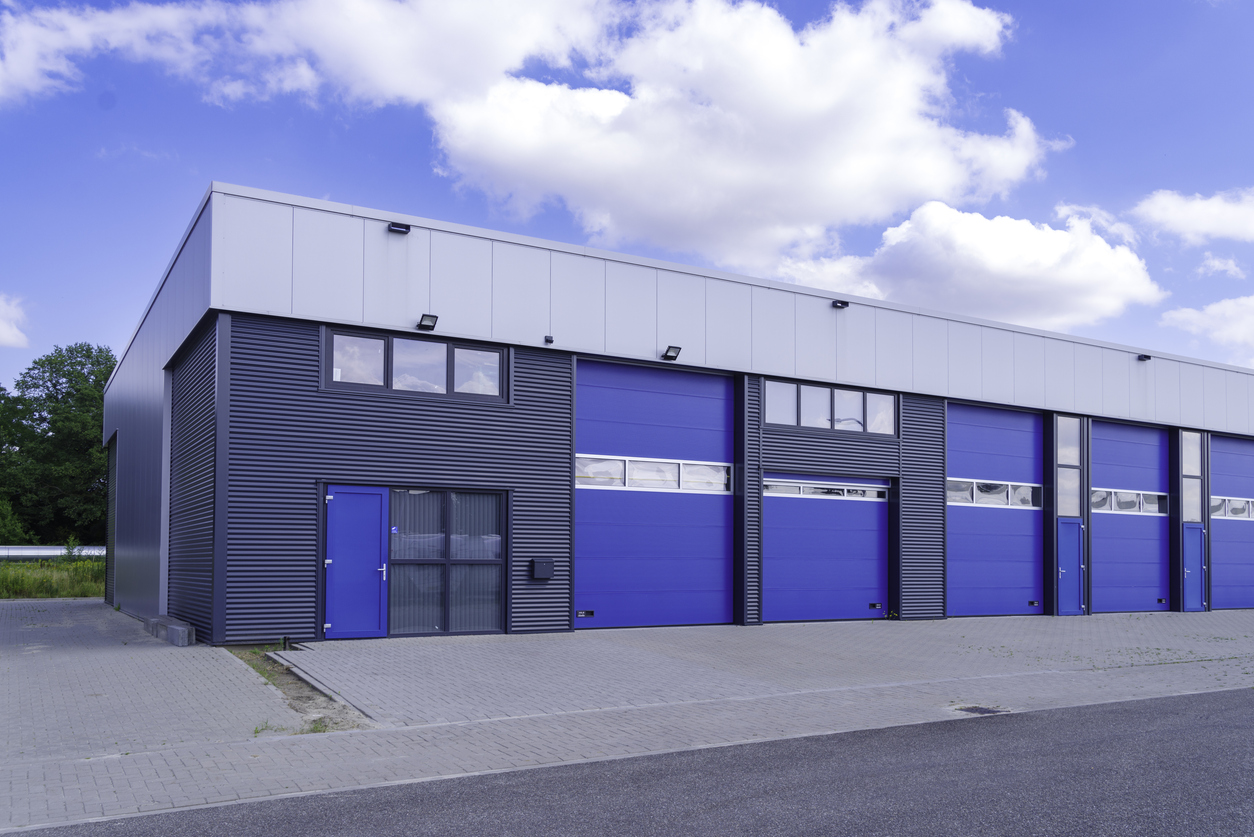
industrial unit with blue shutter doors
High-velocity distribution supports lean inventory strategies, freeing working capital for growth initiatives.
Resilience Emerges From Redundancy
Clusters provide built-in redundancy. Alternative routes, backup suppliers, and multiple service providers create resilience during disruptions such as road closures, labour shortages, or carrier failures.
Isolated facilities lack this network cushioning, amplifying operational risk during unexpected events.
Infrastructure Investment Follows Demand
Public and private infrastructure investment tends to concentrate in logistics clusters. Road upgrades, digital connectivity, and utility reliability improve over time as commercial density increases.
Businesses located within these zones benefit from ongoing infrastructure enhancement without bearing the full cost directly.
Scalability Without Relocation Pressure
As distribution volumes grow, businesses often need additional space, cross-docking capability, or specialised handling services. Clusters provide nearby expansion options without requiring geographic relocation that disrupts routes and staffing.
This continuity simplifies scaling and preserves delivery consistency.
Why Geography Outperforms Floor Area
A slightly smaller warehouse in the right network location often outperforms a larger facility positioned poorly. Time savings compound across every shipment, every route, and every staffing cycle.
Distribution efficiency is shaped less by what happens inside the building and more by how easily the building connects to everything around it.
In logistics, speed, reliability, and resilience emerge from networks, not structures. Choosing a warehouse within a mature logistics cluster aligns daily operations with the flow of commerce rather than fighting against it.